|
Replacing the
Columaire’s Interstage Transformer
With a Cathode‑Follower Phase Splitter
When Westinghouse introduced the Columaire at the
dawn of the 1930s, it represented the height of Canadian radio
craftsmanship. Its tall Art Deco cabinet and powerful push-pull
audio stage gave it a presence that was as much architectural as
electrical. Beneath its elegant exterior, however, lay a small but
essential component that made this impressive sound possible: the
interstage coupling transformer.
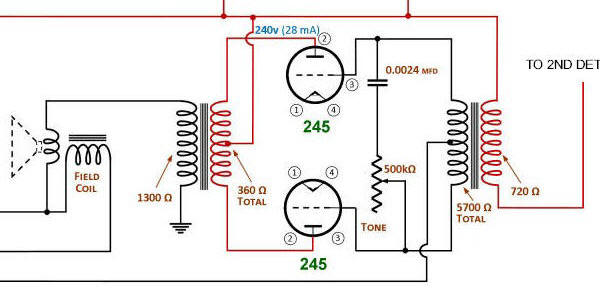 In
early radio design, this transformer served a critical role. The
audio signal produced by the detector and first audio amplifier had
to be divided into two equal but opposite signals before it could
properly drive the pair of output tubes operating in push-pull
configuration. The interstage transformer, shown at the right
accomplished this elegantly. It coupled the audio from one stage to
the next while simultaneously creating two mirror-image signals —
one for each output tube. In
early radio design, this transformer served a critical role. The
audio signal produced by the detector and first audio amplifier had
to be divided into two equal but opposite signals before it could
properly drive the pair of output tubes operating in push-pull
configuration. The interstage transformer, shown at the right
accomplished this elegantly. It coupled the audio from one stage to
the next while simultaneously creating two mirror-image signals —
one for each output tube.
When functioning correctly, the result was
powerful, balanced audio with lower distortion and greater
efficiency than a single output tube could provide.
Unfortunately, time has not been kind to these
delicate transformers. Their extremely fine wire windings are prone
to corrosion, internal shorts, and open circuits after nearly a
century of aging. Many surviving Columaires, like this one are
discovered with failed interstage transformers, leaving the output
stage unable to operate correctly. Without those equal and opposite
drive signals, the radio loses much of its audio output — or falls
silent altogether.
Finding an original replacement transformer in
1976 was nearly impossible so I decided to design a circuit using a
vacuum tube 2A7 to do this job. The circuit I designed is known as a
"cathodyne phase inverter",
sometimes called a "cathodyne phase
splitter".
Although the terminology may sound complex, the
principle itself is beautifully simple.
Rather than relying on magnetic windings to split
the signal, the cathodyne uses the natural electrical behavior of a
single triode tube. The incoming audio signal from the preceding
stage is coupled through a capacitor into the grid of the triode.
Equal-value resistors are then connected in both the plate and
cathode circuits.
As the tube amplifies the incoming audio, two
output signals appear simultaneously: one at the plate; and one at
the cathode.
Because of the tube’s inherent operation, these
two signals emerge equal in strength but opposite in phase. When the
plate voltage swings positive, the cathode swings negative by an
equivalent amount, and vice versa.
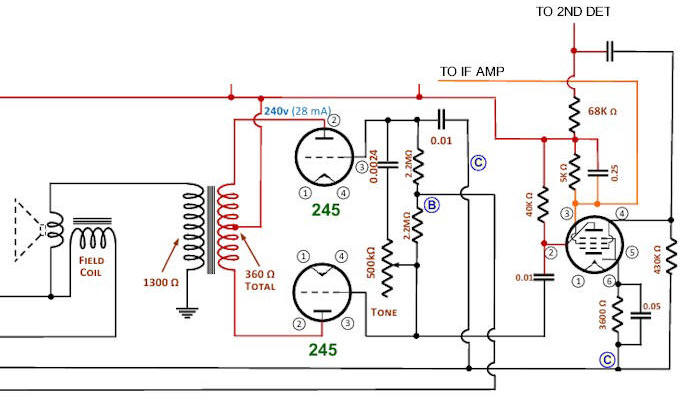 In
this remarkably efficient manner, the cathodyne recreates precisely
what the original transformer once provided: — two balanced
audio signals, equal in amplitude and opposite in phase, ready to
drive the Columaire’s push-pull output stage. In
this remarkably efficient manner, the cathodyne recreates precisely
what the original transformer once provided: — two balanced
audio signals, equal in amplitude and opposite in phase, ready to
drive the Columaire’s push-pull output stage.
Each signal is then coupled through its own capacitor to the grids
of the output tubes, restoring the balanced operation of the
push-pull amplifier.
The advantages of this approach extend beyond
simply replacing a failed component. Unlike aging transformers, the
cathodyne phase inverter introduces virtually no transformer hum,
avoids winding deterioration, and provides excellent phase balance
using only a handful of reliable components. Properly implemented,
it offers performance that is often superior to the original
transformer while remaining electrically sympathetic to the spirit
of the original design.
In many ways, this solution reflects the natural
evolution of radio engineering itself. By the mid-1930s, transformer
coupling in audio stages was increasingly replaced by
resistance-coupled phase inverter circuits because of their improved
reliability, lower cost, and superior performance.
Thus, my replacing the Columaire’s fragile
interstage transformer with a cathodyne phase inverter does more
than repair a failed radio. It respectfully combines the
craftsmanship of early 1930s engineering with the quieter wisdom of
later electronic design.
The result is a restoration that preserves both
the sound and the spirit of the Columaire — allowing this literal
'Barn-Find' to continue
speaking with warmth, balance, and authority nearly a century after
it was first built. |