|
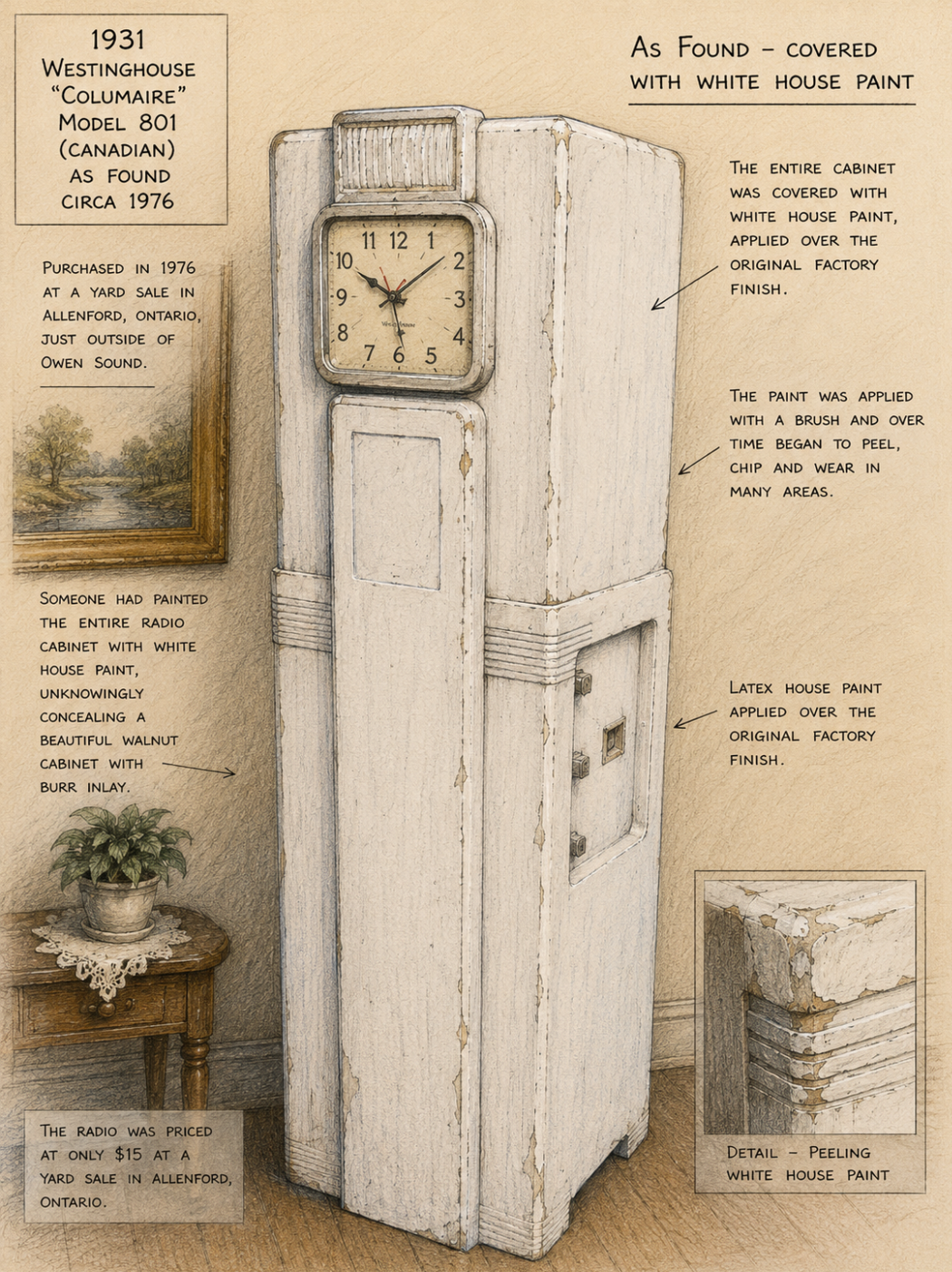
I purchased this remarkable 1931
Westinghouse Columaire Grandmother Clock Radio in 1976 at a small
yard sale in Allenford, Ontario, just outside Owen Sound, where I
currently reside. At the time, however, I was living in Victoria,
British Columbia, which meant the radio would have to survive a
journey across the country before I could begin restoring it.
The radio immediately caught my
attention, although not for the reasons one might expect. At some
point in its life, a previous owner had completely painted the
cabinet white, unknowingly concealing one of the most beautiful Art
Deco radio cabinets ever produced. Combined with the fact that the
radio no longer worked — something that discouraged most buyers in
those days — it was apparently viewed as little more than an
outdated piece of furniture. As a result, the owner priced it at
only fifteen dollars.
When the radio finally arrived in
Victoria, I carefully inspected it for damage from shipping. To my
amazement, it had survived the cross-country trip without a single
scratch. As I examined the cabinet more closely, I noticed that the
white paint was peeling in several places. It appeared the previous
owner had used ordinary latex house paint rather than oil enamel.
Curious to confirm my suspicion, I
removed the chassis from the cabinet and cautiously began testing a
small area using only hot water. To my delight, the white latex
paint softened and released from the cabinet almost effortlessly.
Slowly, the radio began to emerge from what I came to think of as
its “white latex cocoon.” Beneath that layer of paint was a
breathtaking walnut cabinet, complete with a striking walnut burl
inlay on the front panel that had been hidden for years.
Unfortunately, removing the paint also
revealed why someone may have chosen to cover the cabinet in the
first place. Much of the original finish had deteriorated badly,
with extensive peeling and damage throughout the surface. After
carefully stripping the remaining finish, I felt that a cabinet of
such beauty deserved something far more sympathetic than the heavy
polyurethane coatings that were popular at the time.
Instead, I chose to preserve and
highlight the natural beauty of the wood with a traditional
hand-rubbed tung oil finish. Coat after coat was patiently applied
by hand, allowing the walnut grain and burl veneer to develop a
depth and warmth that no sprayed finish could duplicate. It was
slow, painstaking work, and by the final application my hands were
sore from the countless hours of rubbing and polishing.
Yet the effort was worth every minute.
Nearly fifty years later, the finish
remains flawless, and the walnut cabinet still glows with the same
rich warmth and natural beauty that first emerged from beneath that
unexpected layer of white paint in 1976. What once appeared to be an
unwanted and forgotten piece of furniture revealed itself to be one
of the great masterpieces of the Art Deco radio era.
|