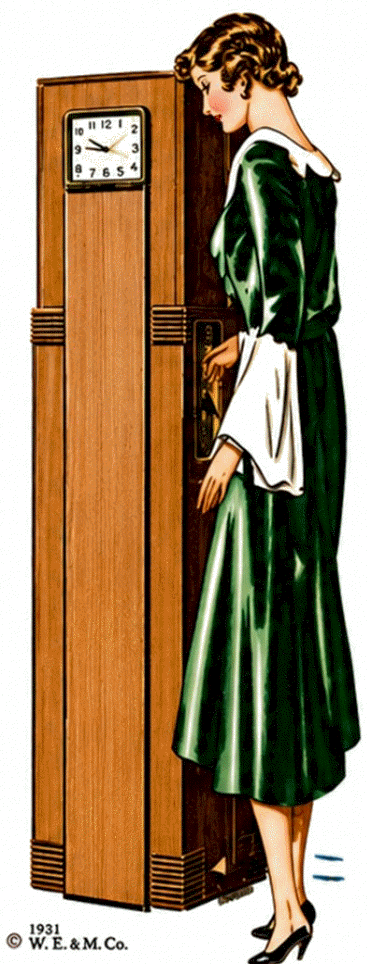

A Compact,
upright Radio that occupies
less than one square foot of floor space
It has a
surprise in its new realism of tone as well as its
practicality and beauty of design. Nine-tubes screen-grid
super-heterodyne, tone control, Electric Clock. Remote
control if you want it.
1931 Westinghouse Columaire 801
The above description is from a 1931 Westinghouse
Radio Advertisement offering the Columaire forsale at the
unbelieveable sum of $193. This included Free
installation. Think about that —
$193 during the height of
the Great Depression —
that's $3,860 in today's
dollars.
In 1931
you could purchase a 1931 Plymouth Model PA sedan for $635
or a Ford Model A Tudor Sedan for $495. To put that in
perspective this radio cost 30% of the cost a new Plymouth.
This gives you an idea of financial status of the families
who were able to purchase the Columaire in 1931. This was a
high end appliance that few people could afford.
Burled Walnut
veneer
One of the most intriguing
features of this radio is its burl inlay. This is one of the
cabinet’s most visually striking and historically
significant decorative features.
Burl walnut was considered a
premium veneer material even in the early 1930s because of
its rare and highly figured grain patterns. Unlike ordinary
straight-grain walnut, burl veneer is cut from abnormal
growth formations in the tree, producing dramatic swirling
patterns, eyes, and feathering that create a rich
three-dimensional appearance when
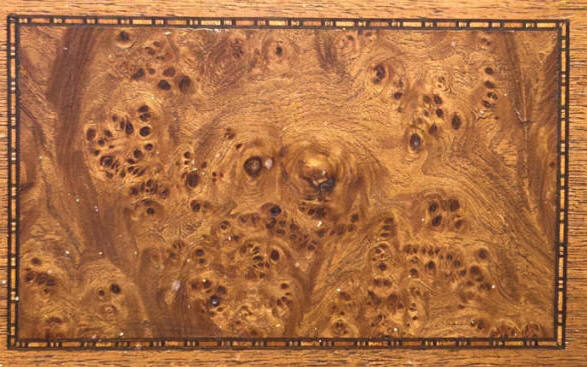 properly
finished. In the Art Deco period, such exotic veneers were
often used sparingly as accent panels to convey luxury,
craftsmanship, and modern sophistication. On the Columaire,
the burl inlay provides an elegant focal point that breaks
up the tall vertical lines of the cabinet and adds warmth
and visual depth to the otherwise architectural styling. properly
finished. In the Art Deco period, such exotic veneers were
often used sparingly as accent panels to convey luxury,
craftsmanship, and modern sophistication. On the Columaire,
the burl inlay provides an elegant focal point that breaks
up the tall vertical lines of the cabinet and adds warmth
and visual depth to the otherwise architectural styling.
Since the burl veneer was
expensive and more difficult to work with than conventional
veneer, its inclusion strongly suggests that the Columaire
was intended to compete in the premium segment of the radio
market. Westinghouse was not merely building a radio; they
were producing a piece of decorative modern furniture
intended to project status and refinement during the early
years of the Great Depression. The fact that this radio
retained its original burl panel beneath the white paint
makes its survival particularly remarkable. The hand-rubbed
tung oil treatment that I used to finish the cabinet made
the natural depth of the burl veneer to become even more
pronounced. This treatment allowed one of the cabinet’s
finest original design elements to re-emerge exactly as its
designers intended nearly a century ago.
Owner's Manual
This Radio comes with a Historical and Technical Manual where you can read about
the history of this 1931 Westinghouse Columinaire Grandmother Clock Radio.
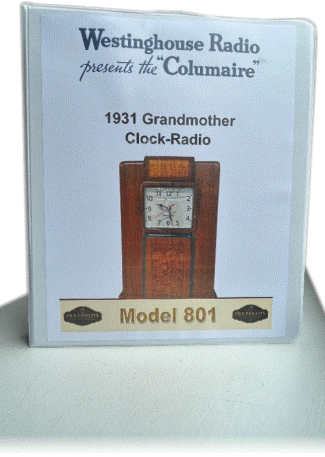 This radio was
manufactured in Hamilton Ontario. The Canadian version of the Columaire, Model
801, was manufactured in Hamilton, Ontario by Canadian
Westinghouse Company in 1931. American versions were sold
under model numbers such as the WR-8. This radio was
manufactured in Hamilton Ontario. The Canadian version of the Columaire, Model
801, was manufactured in Hamilton, Ontario by Canadian
Westinghouse Company in 1931. American versions were sold
under model numbers such as the WR-8.
This manual
also holds important technical information needed
to maintain this valuable antique.

Large Scale
Schematic
This Radio comes equipped with a large scale
technical schematic (24" x 18") that knowledgeable
technicians with a solid understanding of vacuum
tube theory can use to maintain this valuable
antique radio.
|