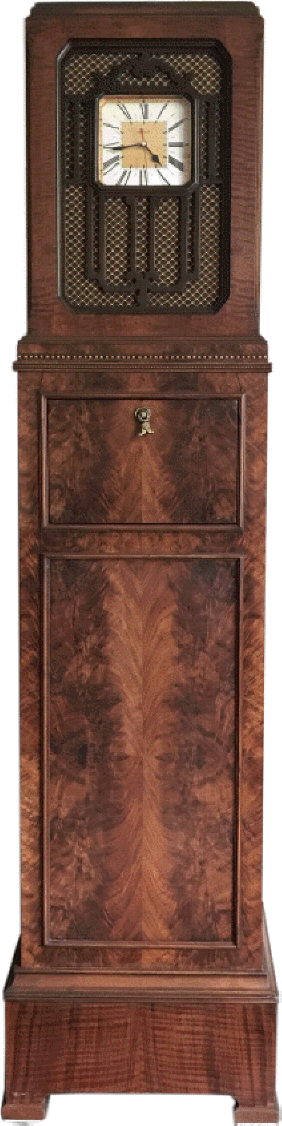
This
1931 Grandfather Clock-Radio was manufactured by De Forest Crosley Radio
Consolidated Industries in Toronto, Ontario. The radio stands 60 inches
tall and is 12 inches wide and 12 inches deep. The cabinet for the radio
was built by McLagan Cabinetry in Stratford, Ontario.
This Superheterodyne radio has eight tubes which are: UY235, UY224,
UY235, UY227, UY227, UX245, UX245 and UX280. It operates with an IF of
175 KHz.
I acquired this radio for
restoration in Ottawa, Ontario in August 2021 from a gentleman who
informed me that it had been in his family for over fifty years. He
recalled that both the radio and the clock had worked at one time and
that he didn't recall the radio been serviced over the years. This
was confirmed when I dismantled the
radio for restoration. There were no signs of extensive repair.
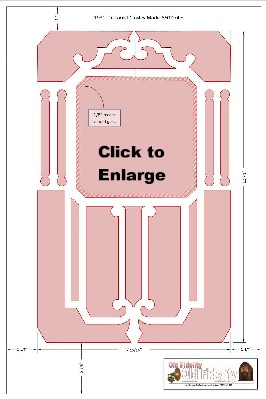
The radio had extensive
damage to the front grille that can be seen in the restoration photos.
There was enough of the grille intact that I was able to draw it on a
new sheet of plywood as shown here.
About the
Manufacturer
DeForest Crosley (Canadian company) and Crosley Radio Corp.
(American company) were separate entities, though connected by licensing
agreements. The Canadian "DeForest Crosley" was based in Toronto and was part of
Rogers Radio, which also made Rogers Majestic radios. They shared chassis
designs with their American counterparts.
The 1931 Grandfather
Clock Radio phenomenon was actually a very short-lived fad in 1931 where US (and
Canadian) radio companies put radios into tall grandfather clock-style cabinets,
usually with electric movements.
NAWCC Forums
The Canadian
DeForest Crosley version — the Carillion (chassis 853) — was a
grandfather clock with specially selected hand-polished California and crotch
walnut woods, using a Hammond Electric Clock movement and 8 tubes, built around
1931/1932.
Radiomuseum.org
One collector
documented finding one with an original warranty card indicating a purchase date
of October 17, 1931. The set stood about 5 feet tall, with a door midway on the
cabinet that opened to reveal the radio controls. The clock was electric and
could be set to activate the radio at a desired hour. Nostalgiaair
The American
Crosley version — the Model 124 "Playtime" — was a larger set. It
measured 67" x 18" x 11" and used an eight-tube chassis.
Worthpoint
It featured a 3-gang tuning capacitor, no AVC, with volume regulated by the
antenna, and included a tone control marketed as a "noise killer."
Radiomuseum.org
The cabinet was
typically done in walnut or Bird's Eye Maple in an elegant Art Deco style.
About the Cabinet
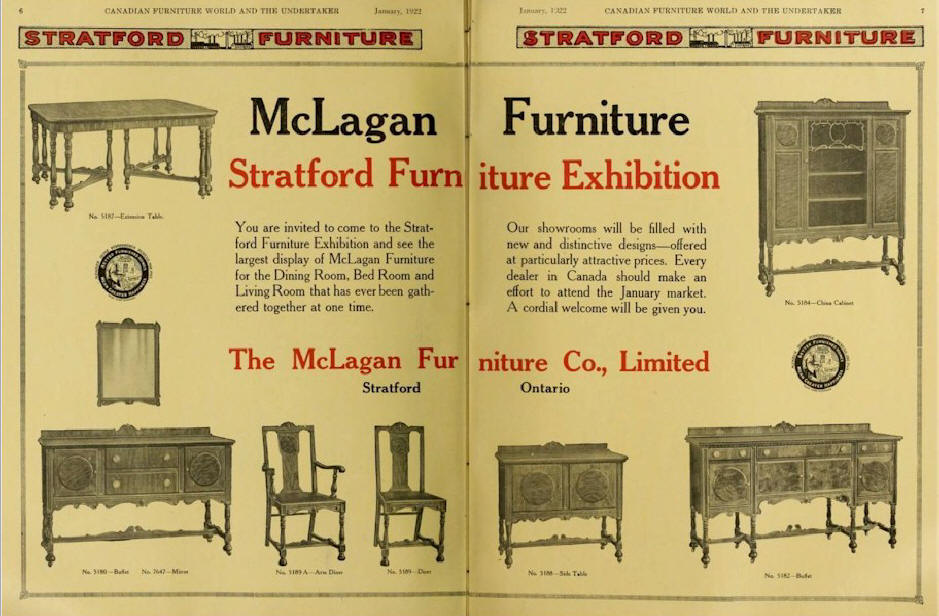
Maker - McLagan Furniture
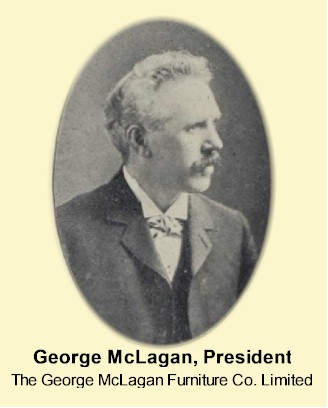
George McLagan’s career in furniture began when he apprenticed in Stratford. He
would relocate for some time to Grand Rapids, Michigan where he continued to
learn about the furniture industry and, importantly, factory production.
Returning
to Stratford he established McLagan and Porteous with local businessman Robert
Porteous. Porteous retired in 1898 and their original plant on Mill Street
(today Douglas Street between Huron Street and St. Vincent Street) burned down
March 1st, 1900. A year later McLagan built a four-storey, $35,000 factory at 93
Trinity Street in what would become Stratford’s factory district. For over
twenty years he designed all of his furniture, and after 1910 fifty percent.
In 1908, he built a
Beaux-Arts style mansion at 210 Water Street that still exists today. He died in
1918 but the business continued under the McLagan name until sometime between
1937 and 1939 according to city directories.
During the war, 93
Trinity Street was converted into a barracks where it housed Dutch soldiers from
January 1941 until Autumn 1942.
In 1951, Imperial Furniture Company relocated from 411 Albert Street to 93
Trinity Street. Under Dutch designer, Jan Kuypers, the company helped modernize
Canadian furniture with innovative Scandinavian designs.
In its 100th year
Kitchener-based Krug furniture purchased Imperial Furniture in 1980 for its
kiln-drying operations since it had exceeded capacity at its Kitchener factory.
A local who lives across the street from Krug told me that the plant still kiln
dries lumber albeit on a reduced shift.
 The American
Crosley version — the Model 124 "Playtime" — was a larger set. It
measured 67" x 18" x 11" and used an eight-tube chassis.
The American
Crosley version — the Model 124 "Playtime" — was a larger set. It
measured 67" x 18" x 11" and used an eight-tube chassis.
 Returning
to Stratford he established McLagan and Porteous with local businessman Robert
Porteous. Porteous retired in 1898 and their original plant on Mill Street
(today Douglas Street between Huron Street and St. Vincent Street) burned down
March 1st, 1900. A year later McLagan built a four-storey, $35,000 factory at 93
Trinity Street in what would become Stratford’s factory district. For over
twenty years he designed all of his furniture, and after 1910 fifty percent.
Returning
to Stratford he established McLagan and Porteous with local businessman Robert
Porteous. Porteous retired in 1898 and their original plant on Mill Street
(today Douglas Street between Huron Street and St. Vincent Street) burned down
March 1st, 1900. A year later McLagan built a four-storey, $35,000 factory at 93
Trinity Street in what would become Stratford’s factory district. For over
twenty years he designed all of his furniture, and after 1910 fifty percent.