 The
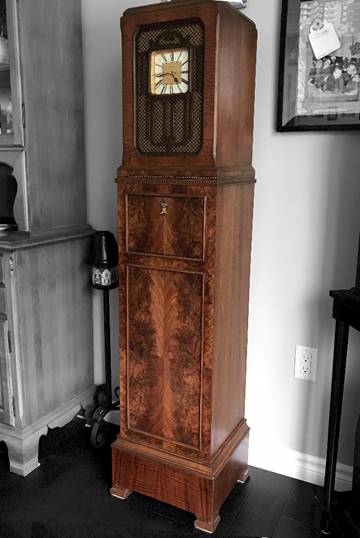
DeForest Crosley Model 850
The
DeForest Crosley Model 850
A Rare Canadian Grandmother
Clock Radio
from the Dawn of the Depression Era
In the
early years of radio broadcasting, there was a brief and remarkable period when
radio manufacturers attempted something far more ambitious than simply building
electronic receivers. They sought to create objects of beauty — grand pieces of
furniture that would symbolize modernity, prosperity, sophistication, and
technological progress within the home.
Among the
finest surviving examples of this artistic and industrial ambition is the 1931
DeForest Crosley Model 850 Grandmother Clock Radio.
Standing
tall and elegant, the Model 850 was never intended to be merely a radio. It was
designed as a centerpiece for the modern Canadian household — an object that
blended fine furniture craftsmanship, advanced electrical engineering, and
decorative design into a single luxurious creation.
Today,
nearly a century later, surviving examples of the Model 850 are exceptionally
rare. For collectors of Canadian radios, Art Deco furniture, and early
electrical technology, the DeForest Crosley 850 represents one of the most
visually distinctive and historically significant radio designs produced in
Canada during the Great Depression.
The example
presented here, serial number 8504943, survives as a remarkable artifact from
that extraordinary era.
Canada’s Radio Boom
To
fully appreciate the significance of the Model 850, it is important to
understand the remarkable growth of the Canadian radio industry during the late
1920s and early 1930s.
Radio
broadcasting had exploded in popularity during the 1920s. Families gathered
nightly around glowing receivers to hear news, music, drama, sporting events,
political speeches, and live entertainment arriving magically through the air.
For many
households, the radio became the center of domestic life.
Canadian
manufacturers quickly recognized the tremendous demand for radio receivers and
began building large industrial operations capable of competing with American
companies.
Among the
most important of these firms was DeForest Crosley Radio Corporation of Toronto.
The
company emerged from the combination of two influential names in radio history:
·
Lee De Forest, the pioneering inventor whose
vacuum tube innovations helped make radio broadcasting possible;
·
and Powel Crosley Jr., the American entrepreneur
whose affordable radio sets revolutionized home entertainment.
Although the Canadian operation eventually became largely independent from the
American Crosley company, the DeForest Crosley brand retained tremendous
prestige throughout Canada.
By the
late 1920s, DeForest Crosley had become one of the largest radio manufacturers
in the British Empire.
Its
Toronto factories produced:
·
radio chassis,
·
loudspeakers,
·
cabinets,
·
transformers,
·
and luxury console receivers.
The
company marketed its products as modern, sophisticated, and distinctly Canadian.
Luxury During Hard Times
The timing of the Model 850’s introduction makes the set particularly
fascinating.
The
radio was produced during approximately 1931–1932 — the darkest years of the
Great Depression.
Economic hardship was widespread. Factories closed. Unemployment soared.
Families struggled financially.
Yet
paradoxically, radio ownership continued to expand.
Manufacturers understood that consumers could no longer justify spending large
sums of money on simple appliances. To survive economically, radio companies
increasingly marketed their products as luxury furniture investments rather than
mere electronics.
The
DeForest Crosley Model 850 emerged directly from this strategy.
Rather than building an ordinary console radio, DeForest Crosley created an
elegant grandmother clock cabinet that concealed a powerful eight-tube radio
receiver within.
The
result was both practical and theatrical.
The
radio became:
·
a household timepiece,
·
a decorative furnishing,
·
a symbol of modern electrical convenience,
·
and a source of entertainment.
Even today, the cabinet retains an imposing and graceful presence.
Its
tall proportions, refined lines, and carefully balanced styling distinguish it
immediately from conventional radio consoles of the period.
The
design reflects a transitional moment between:
·
traditional furniture craftsmanship,
·
late Victorian longcase clock design,
·
and the emerging geometric influence of Art Deco
styling.
This combination gives the Model 850 a timeless elegance rarely matched by later
radio designs.
Consolidated Industries Limited
One of the most
intriguing aspects of the Model 850 is the “Consolidated Industries Ltd.”
imprint found upon the chassis.
This marking reveals
an important chapter in Canadian industrial history.
In 1931, DeForest
Crosley underwent a major corporate reorganization under the leadership of Major
James E. Hahn. The company became part of a larger holding organization known as
Consolidated Industries Limited.
This new corporation
unified several electrical and appliance interests under a single corporate
umbrella.
These included:
·
DeForest Crosley radios,
·
Hammond electric clocks,
·
Norge refrigerators,
·
and related appliance businesses.
This relationship is
particularly important because the Model 850 integrated both radio and clock
technologies into one product.
It is believed that
the clock mechanism itself was connected to Hammond clock manufacturing
interests operating within the Consolidated Industries organization.
As a result, the
Model 850 was more than simply a radio with a clock attached.
It represented an
early example of integrated home electrical design — a sophisticated combination
of technologies intended to symbolize modern living.
At the time,
electric clocks themselves were still considered somewhat luxurious.
The use of a
reliable synchronous electric clock movement added prestige and functionality to
the radio while reinforcing the company’s image as a leader in modern electrical
innovation.
Advanced Engineering for Its Day
While the cabinet
attracts immediate attention, the engineering inside the Model 850 was equally
impressive for its time.
The receiver
employed an advanced eight-tube superheterodyne chassis — a sophisticated design
during the early 1930s.
The radio featured:
·
AC-powered operation,
·
a powerful push-pull audio output stage,
·
and an electrodynamic loudspeaker capable of
delivering room-filling sound.
Compared to
entry-level receivers of the period, the Model 850 occupied the premium end of
the market.
Its sound quality
and reception performance would have been considered excellent in 1931.
At a time when many
households still relied upon battery-powered sets with limited audio output, the
Model 850 represented modern convenience and technical sophistication.
Listeners would
have gathered around the glowing dial to hear:
·
dance orchestras,
·
hockey broadcasts,
·
political speeches,
·
news bulletins,
·
and live network entertainment.
For many families,
the radio connected them to the wider world during an uncertain and rapidly
changing period of history.
A Rare Survivor
Today,
surviving examples of the DeForest Crosley Model 850 are extraordinarily
uncommon.
Several
factors contributed to the low survival rate.
First,
specialty furniture radios generally sold in much smaller numbers than
conventional consoles.
Second, the
tall cabinet design made the radio vulnerable to damage.
Over the
decades, many examples suffered from:
·
veneer deterioration,
·
moisture damage,
·
broken clock mechanisms,
·
cabinet instability,
·
and improper storage.
Large
floor-standing radios were frequently discarded during the postwar years when
newer television sets and compact hi-fi systems became fashionable.
As a result,
relatively few complete examples survive today.
The survival
of serial number 8504943 is therefore historically significant in itself.
Even more
remarkable is the fact that the radio has reportedly undergone professional
restoration while preserving its original appearance and character.
The cabinet
has been refinished to a high standard, the electronics restored for reliable
operation, and tasteful Bluetooth/FM functionality added to allow modern
listening while preserving the radio’s historical integrity.
This
combination of restoration and usability allows the radio to function once again
as it was originally intended — not merely as a display object, but as a living
piece of household technology.
Art Deco Elegance
The
Model 850 occupies a unique place within the evolution of industrial design.
Its cabinet
reflects the growing influence of Art Deco styling that swept through
architecture, furniture, and consumer products during the late 1920s and early
1930s.
Unlike the
heavily carved Victorian furniture of earlier decades, the Model 850 embraced:
·
cleaner vertical lines,
·
balanced geometric proportions,
·
restrained ornamentation,
·
and an emphasis on elegance through form rather
than excessive decoration.
The
result is a radio that still appears sophisticated nearly one hundred years
later.
Collectors
often describe the Model 850 as one of the most visually impressive Canadian
radio cabinets ever produced.
Its narrow
vertical form gives it a commanding architectural presence while occupying
surprisingly little floor space.
Placed
within a period home, library, office, or collection room, the radio immediately
becomes a conversation piece.
>Collector Interest and
Historical Importance
Among
advanced collectors of Canadian radios, the Model 850 enjoys a reputation as one
of the most desirable and unusual Depression-era sets.
It appeals
simultaneously to several collector communities:
·
vintage radio collectors,
·
Art Deco enthusiasts,
·
furniture historians,
·
clock collectors,
·
and museum curators interested in early
industrial design.
Its rarity
further increases collector demand.
Public
sales records are scarce, and examples rarely appear on the open market.
Professionally restored examples with strong cosmetic presentation are
especially difficult to locate.
Because the
Model 850 combines so many desirable characteristics — rarity, scale, historical
significance, and visual impact — it occupies a special place within Canadian
radio collecting.
It
represents a period when manufacturers were willing to create bold, imaginative
products that blurred the line between technology and fine furniture.
More Than a Radio
Perhaps
the greatest significance of the DeForest Crosley Model 850 lies in what it
represents culturally.
This was
not merely an appliance.
It was a
symbol of optimism.
During one
of the most difficult economic periods in modern history, companies like
DeForest Crosley continued to produce beautiful and ambitious products that
celebrated innovation, craftsmanship, and the promise of modern electrical
living.
The Model
850 reflected the belief that technology could improve daily life while also
bringing elegance and beauty into the home.
Today,
surviving examples serve as reminders of that remarkable period in Canadian
industrial history.
The radio
stands not only as a collectible object, but as a work of functional decorative
art.
Serial
number 8504943 survives as an exceptional example of this heritage — a rare
Canadian masterpiece from the golden age of radio.
Nearly a
century after it first stood proudly in a Canadian living room, the DeForest
Crosley Model 850 continues to command attention, admiration, and respect.
It remains
one of the finest surviving expressions of Canada’s early radio industry and one
of the most distinctive clock radios ever produced.