|
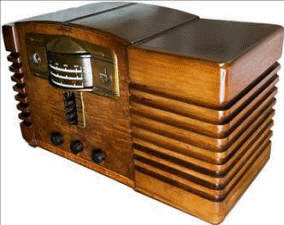
The 1939 Sparton Model
7140 radio
A Canadian
Masterpiece of Sound, Craftsmanship, and Innovation
Introduction:
A Voice from Another Era
 There
are radios—and then there are instruments of history. The 1939 Sparton
Model 7140 belongs firmly in the latter category. Built on the eve of
the Second World War, this remarkable Canadian-made receiver represents
a moment when radio was not merely a convenience, but the very heartbeat
of the modern world. Families gathered around sets like this to hear
world events unfold in real time, to listen to music carried invisibly
across continents, and to connect with a rapidly changing global
landscape.
There
are radios—and then there are instruments of history. The 1939 Sparton
Model 7140 belongs firmly in the latter category. Built on the eve of
the Second World War, this remarkable Canadian-made receiver represents
a moment when radio was not merely a convenience, but the very heartbeat
of the modern world. Families gathered around sets like this to hear
world events unfold in real time, to listen to music carried invisibly
across continents, and to connect with a rapidly changing global
landscape.
Today, the Sparton 7140 stands as far more than
an artifact. It is a testament to engineering excellence, industrial
craftsmanship, and the enduring appeal of analog sound. For collectors,
restorers, and historians alike, it is a radio that deserves both
admiration and preservation.
Canadian Craftsmanship:
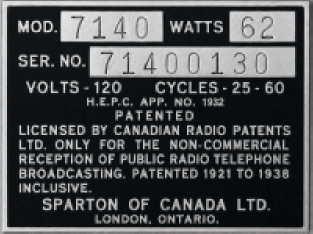
Built in London, Ontario
The Sparton 7140
was manufactured in London, Ontario, by Sparton of Canada Ltd., a
subsidiary of the American Sparks-Withington Company. By the late 1930s,
Sparton had established itself as one of the leading radio manufacturers
in Canada, producing sets that rivaled—and often exceeded—the quality of
their American counterparts.
Unlike
mass-produced modern electronics, each Sparton radio was built with a
level of care and durability that reflected its importance in daily
life. Radios were not disposable items; they were investments. The 7140,
positioned as a mid- to upper-tier tabletop model, would have been a
proud centerpiece in a Canadian home—both a functional device and a
piece of fine furniture.
Its wooden
cabinet, often styled with subtle Art Deco influence, reflects the
design sensibilities of the era: clean lines, balanced proportions, and
an understated elegance. The craftsmanship extends beyond the exterior.
Inside, the chassis reveals careful layout, high-quality components, and
a thoughtful engineering approach that prioritized both performance and
serviceability.
Engineering
Excellence:
A True Seven-Tube Superheterodyne
 At the heart of
the Sparton 7140 lies a sophisticated seven-tube superheterodyne
circuit—a design that was considered advanced for its time. Unlike
simpler five-tube radios that dominated the lower end of the market, the
7140 incorporates additional stages that significantly enhance
performance. At the heart of
the Sparton 7140 lies a sophisticated seven-tube superheterodyne
circuit—a design that was considered advanced for its time. Unlike
simpler five-tube radios that dominated the lower end of the market, the
7140 incorporates additional stages that significantly enhance
performance.
The inclusion of
a dedicated radio frequency (RF) amplifier stage sets this model apart.
This feature improves both sensitivity and selectivity, allowing the
radio to pick up weaker stations and separate them more clearly from
adjacent signals. For listeners in rural Canada or those exploring
shortwave broadcasts, this was a major advantage.
The signal
path—from antenna through RF amplification, frequency conversion,
intermediate frequency (IF) amplification, detection, and finally audio
output—is executed with precision. Operating at a standard IF frequency
of 456 kHz, the set delivers stable and reliable tuning, even across
multiple bands.
Perhaps most
impressive is the audio stage. The use of a 6F6 output tube driving a
large 10-inch electrodynamic speaker provides rich, room-filling sound.
Unlike the smaller speakers found in many contemporary sets, this
configuration produces a warmth and depth that modern listeners often
find surprisingly engaging.
Features That Defined an Era
The Sparton 7140
was designed not only for performance, but also for user experience. It
incorporates a number of features that would have been considered
premium in 1939.
Multiband
Reception
the standard AM broadcast band, the radio includes shortwave and
“police” bands. This expanded coverage allowed listeners to tune in to
international broadcasts, maritime communications, and other distant
signals. In an age before television and the internet, this capability
opened a window to the world.
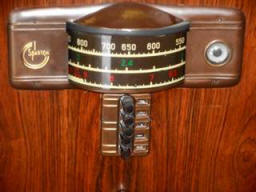
Pushbutton
Tuning
also a priority. The 7140 features pushbutton tuning presets, enabling
users to quickly access their favorite stations without manual
adjustment. This was a relatively modern innovation at the time and
reflected the industry’s move toward greater ease of use.
Magic Eye Tuning
Indicator
visually striking elements of the radio is the 6E5 “magic eye” tuning
indicator. This glowing green display responds to signal strength,
closing as a station is tuned in accurately. It serves both a practical
function and a touch of theatrical charm, embodying the fascination with
electronic technology that defined the era.
Drum Dial
Mechanism
uniqueness is the drum-style tuning dial—a cylindrical mechanism that
rotates to display station frequencies. This design is less common than
flat dial scales and contributes to the radio’s distinct character. It
is both mechanically intriguing and aesthetically appealing, offering a
tactile connection to the tuning process.
A Window to the World
To truly
appreciate the Sparton 7140, one must consider the historical context in
which it was used. In 1939, radio was the primary medium for news and
entertainment. It brought voices into the home—voices that carried
information, reassurance, and sometimes тревelling reports from across
the globe.
As the world
edged toward war, sets like the 7140 became essential tools for staying
informed. Families would gather in the evening to listen to broadcasts
from the CBC, the BBC, and other international stations. The shortwave
bands, in particular, allowed Canadians to hear firsthand accounts from
distant countries, fostering a sense of connection that transcended
geography.
In this way, the
7140 was more than a receiver. It was a bridge between worlds.
Restoration
and Preservation:
Keeping History Alive
Today, surviving
examples of the Sparton 7140 are prized by collectors and restorers.
While time inevitably takes its toll—particularly on components such as
capacitors and wiring—the underlying construction of the radio is
remarkably robust.
A proper
restoration involves careful replacement of aging capacitors, inspection
of transformers and the field coil speaker, and precise alignment of the
IF and RF stages. When completed, the results can be extraordinary.
These radios are not merely display pieces; they are fully functional
instruments capable of delivering authentic vintage sound.
For those who
undertake such work, the process is as rewarding as the outcome. Each
restored radio represents a piece of history brought back to life—a
connection to the craftsmanship and ingenuity of a bygone era.
Why the Sparton 7140 Matters Today
In a world
dominated by digital technology, the Sparton 7140 offers something
fundamentally different. It invites us to slow down, to engage with
sound in a more deliberate way, and to appreciate the physical
mechanisms that make communication possible.
Its significance
lies not only in its technical features, but also in what it represents:
A pinnacle
of prewar radio design
A product of
Canadian industrial heritage
A symbol of
connection in uncertain times
An enduring
example of quality and craftsmanship
For collectors,
it is a rare and desirable model. For historians, it is a tangible link
to the past. For anyone who experiences it in operation, it is a
reminder of the magic that radio once held—and still holds today.
Conclusion:
A Radio Worth Celebrating
The Sparton
Model 7140 is more than an object. It is a story—of innovation, of
craftsmanship, and of human connection. From its carefully engineered
circuitry to its elegant cabinet design, every aspect of the radio
reflects a commitment to excellence.
To own, restore,
or even simply observe such a piece is to engage with history in a
meaningful way. It is to hear echoes of a time when the world gathered
around a glowing dial, listening intently as voices traveled across the
airwaves.
In preserving
and celebrating the Sparton 7140, we do more than honor a single
radio—we honor an era.
|