APPRAISAL REPORT
 Identification
Client Reference: Private
Collection
Manufacturer:
Canadian General Electric Ltd.
Model: Model K80
Year of Manufacture: 1931
Serial Number:
D45
Place of Manufacture:
Toronto, Ontario, Canada
Report Date: 2026-05-14
Purpose of Appraisal:
Insurance, Estate, and Fair Market Valuation
Prepared by: GPT Research & Historical Analysis
Executive Summary
The
1934 Canadian General Electric Model K-80 represents one of the finest examples
of Canadian radio engineering produced during the golden age of radio. Combining
dramatic gothic styling with an advanced multi-band chassis, the K-80 was
originally marketed as a premium “all-wave” receiver intended for affluent
households and serious radio enthusiasts during the depths of the Great
Depression.
The
example evaluated in this report is especially noteworthy because it
incorporates a professionally installed external modern audio interface module
that allows the radio to receive contemporary FM broadcasts, play digital music
files from USB media, and stream wireless audio from smartphones and tablets
through Bluetooth connectivity.
This
combination of historic authenticity and modern usability substantially enhances
the radio’s appeal to contemporary collectors and non-collector buyers alike.
While many antique radios today are admired primarily as decorative objects, the
addition of modern audio functionality transforms the K-80 into a practical
daily-use entertainment system while preserving its original historical
appearance.
As a
result, this particular radio occupies a unique and increasingly desirable
category within the vintage radio market: a museum-quality historical artifact
that can still function as part of modern everyday life.
Historical Significance
The
Canadian General Electric K-80 was introduced during the 1933–1934 model year at
the height of radio’s golden age. Manufactured by Canadian General Electric
Company Ltd. in Toronto, Ontario, the K-80 was designed as an upper-tier premium
receiver intended to compete with the finest all-wave radios available in North
America.
The
radio utilized an advanced superheterodyne chassis with multiple shortwave bands
in addition to standard AM broadcast reception. During the early 1930s,
shortwave listening represented one of the most exciting technological
developments available to consumers. Owners could hear international broadcasts
from Europe, South America, Asia, and around the world directly from their
homes.
This
capability transformed radios such as the K-80 from simple household appliances
into symbols of modernity, sophistication, and international awareness.
At
approximately $92.50 in 1934, the K-80 was an expensive luxury purchase.
Adjusted for inflation, this equates to approximately $2,500–$3,000 in modern
Canadian currency. During the Great Depression, ownership of a radio of this
caliber would generally have been limited to affluent or upper-middle-class
households.
The
K-80 remains highly regarded among collectors because of:
>>> its relatively low
Canadian production numbers
>>> its exceptionally
elaborate chassis
>>> its large dynamic
speaker
>>> its
communications-grade sensitivity and
>>> its striking
gothic cabinet design
Today, surviving examples are considered among the more desirable Canadian
tombstone radios of the early 1930s.
Cabinet and Design Evaluation
The
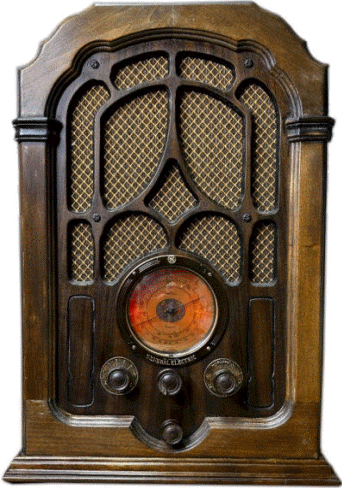
K-80 cabinet is one of the defining visual features of the model.
The
dramatic gothic arch, decorative grille work, and rich walnut veneers exemplify
the influence of Depression-era industrial design, when radios were
intentionally styled as elegant furniture pieces meant to dominate the family
living room.
The
cabinet proportions are unusually bold and visually balanced, giving the radio a
commanding presence even by modern standards. The elaborate grille pattern and
cathedral-inspired styling remain highly sought after among collectors because
they represent the peak of early 1930s radio aesthetics.
When
professionally refinished while preserving the original character of the
cabinet, the K-80 becomes not only a collectible electronic device but also an
important decorative artifact from the Art Deco and Depression-era design
period.
Chassis and Technical Evaluation
The
K-80 chassis was substantially more advanced than most consumer radios of its
era.
Features included:
@ multiple RF stages
@ broadcast and
shortwave band coverage
@ precision tuning
capability
@ large electrodynamic
speaker
@ high sensitivity and
selectivity
@ heavy-duty power
supply construction
Collectors and restorers frequently describe the K-80 chassis as “communications
grade” because of its unusually sophisticated engineering.
When
electronically restored to proper operating condition using modern capacitors
and electrical servicing techniques, the radio remains capable of excellent
performance on the surviving AM broadcast band.
However, the decline of AM broadcasting in North America has created a practical
challenge for many antique radios. While historically important, many vintage
sets today receive only a limited number of local AM stations, reducing their
usefulness for modern listeners.
This
is where the modern audio integration module dramatically changes the ownership
experience.
FM / Bluetooth / USB Audio Integration
The
professionally installed external audio interface module supplied with this
radio represents a major enhancement in both practicality and market appeal.
The
module enables the radio to:
o receive modern FM
radio broadcasts
o stream wireless
Bluetooth audio from smartphones and tablets
o play digital music
files from USB storage devices
Importantly, the module plugs into the rear of the radio and does not
permanently alter the original cabinet appearance. This preserves the historical
integrity and collectibility of the radio while dramatically expanding its
usability.
Why This Feature Matters
One
of the largest challenges facing antique radio ownership today is practical
usability.
Most
consumers no longer listen regularly to AM broadcasting. In many regions, only a
small number of AM stations remain active, and audio quality is often poor
compared to modern FM or digital streaming sources.
Without a modern interface, many vintage radios become decorative objects that
are only occasionally demonstrated.
The
FM/Bluetooth/USB module completely changes this dynamic.
Instead of functioning only as a historic artifact, the K-80 becomes:
o a fully usable daily
entertainment system
o a Bluetooth speaker
with exceptional vintage sound character
o an FM receiver with
authentic 1930s styling
o a conversation piece
combining historic craftsmanship with modern convenience
Owners can now:
o stream Spotify or
Apple Music through the original speaker
o listen to local FM
stations daily
o play digital music
collections from USB storage
o enjoy wireless audio
throughout the home
The
experience is fundamentally different from listening through modern plastic
Bluetooth speakers. The large wooden cabinet and electrodynamic speaker produce
a warm, rich acoustic character impossible to duplicate with modern compact
devices.
Effect on Collector Value
The
addition of a modern audio interface can affect collector value in two distinct
ways depending on the type of buyer.
Traditional Purist Collectors
A
small segment of collectors prefers radios to remain entirely original without
any modern modifications whatsoever. For these individuals, any alteration —
even reversible ones — may slightly reduce desirability.
However, because this module is external, removable, and does not visibly alter
the cabinet or chassis appearance, the impact on historical authenticity is
minimal.
Modern Collectors and General Buyers
For
the much larger modern market, the FM/Bluetooth capability significantly
increases desirability.
Today’s buyers increasingly want vintage radios that:
> can actually be
used
daily
> integrate with modern
technology
> provide practical
entertainment value
> maintain original
visual authenticity
As a
result, professionally integrated Bluetooth/FM systems often increase
saleability and broaden the market substantially.
In
many cases, radios equipped with high-quality Bluetooth/FM integration:
l
sell faster
l
attract younger
buyers
l
command premium
prices over non-working or AM-only examples
This
is especially true for visually dramatic radios such as the K-80.
Market Assessment
The
market for premium Canadian tombstone radios remains relatively strong because:
-
Canadian production
numbers were comparatively low
-
survival rates are
limited
-
cabinet quality was
exceptionally high
-
advanced multi-band
models are highly sought after
The
K-80 occupies an upper tier within Canadian radio collecting circles.
Factors positively affecting value include:
-
professional
electronic restoration
-
excellent cabinet
condition
-
originality of major
components
-
operational status
-
rarity,
and
-
tasteful modern
usability upgrades
The
FM/Bluetooth/USB module substantially increases practical ownership appeal
without significantly compromising historical integrity.
Estimated Market Value
Based upon
a review of photos and videos provided by the owner and:
l
historical
significance
l
rarity
and collector demand
l
cabinet desirability
l
restoration quality
l
operational
performance, and
l
inclusion of
modern audio integration capability
the
estimated current market value of this professionally restored Canadian General
Electric K-80 equipped with a removable FM/Bluetooth/USB module is
approximately:
Estimated Current Value:
$2,500 – $4,000 CAD
Conclusion
The
1934 Canadian General Electric Model K-80 represents one of the finest surviving
examples of Canadian radio design from the golden age of broadcasting.
Its
dramatic gothic styling, advanced engineering, and historical significance
already make it a highly desirable collector’s radio. However, the addition of a
professionally integrated FM/Bluetooth/USB interface transforms the radio into
something even more remarkable: a historical artifact that remains fully usable
in modern everyday life.
Rather than sitting silently as a decorative object, this radio can once again
serve as the center of a room exactly as it did during the 1930s — now
delivering modern digital music and FM broadcasting through its original speaker
system.
This
successful blending of historic preservation and modern functionality greatly
enhances both the ownership experience and the radio’s appeal to today’s market.
The
K-80 is therefore best understood not merely as an antique radio, but as a fully
functional piece of living technological history.