Where Was It Made?
The
radio was manufactured by Canadian General Electric, commonly abbreviated CGE.
During the early 1930s, Canadian General Electric operated major manufacturing
facilities in:
o Toronto, Ontario
o Peterborough, Ontario
Evidence strongly suggests that most CGE radio production in this period
occurred in the Toronto operations, where the company had vacuum tube and radio
manufacturing capability beginning in the 1920s. (Wikipedia)
The
radio cabinet itself may have been subcontracted to a cabinet maker, which was
common practice at the time, while final assembly and chassis production were
performed by CGE.
What Did It Sell For?
One
of the best surviving references places the selling price at approximately:
$92.50 USD in 1933–1934
That
was an enormous amount of money during the Great Depression.
Adjusted for inflation, that equals roughly:
About $1,900–$2,000 USD today
Roughly $2,500–$2,800 CAD today
depending on the inflation calculator used.
Was It an Expensive Radio?
Absolutely.
The
K-80 was not an entry-level family radio. It was a premium upper-tier receiver
aimed at affluent households and serious radio enthusiasts.
For comparison in
1934:
|
Item |
Approximate Cost |
|
Economy table radio |
$15–$30 |
|
Mid-range console radio |
$40–$60 |
|
GE
K-80 |
~$92.50 |
|
New
automobile |
~$500–$600 |
A worker during
the Depression might earn:
$15–$25
per week
sometimes
less
So purchasing a
K-80 could represent:
one to
two months of wages
or more
during the worst Depression years
It would
definitely have been viewed as a luxury purchase.
Why Was It So Expensive?
The
K-80 included features normally found only in elite receivers:
Advanced Multi-Band Reception
Shortwave listening was extremely popular in the early 1930s. Owners could
hear:
o Europe
o South America
o maritime transmissions
o international
broadcasters
This gave the radio a futuristic, global appeal.
Large High-Quality Speaker
The set used a large electrodynamic speaker with a field coil, providing
much richer sound than inexpensive radios. (Radiomuseum)
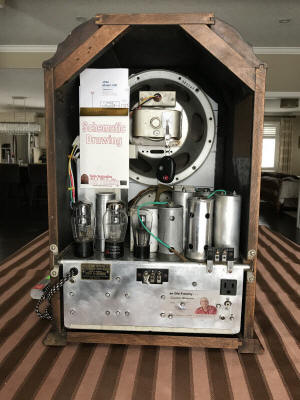
Sophisticated Chassis
Collectors note:
o multiple RF stages
o precision tuning
o exceptional
sensitivity
o communications-grade
construction
One restoration article described the chassis as far more elaborate than
most consumer radios of the era. (radioattic.com)
Cabinet Design
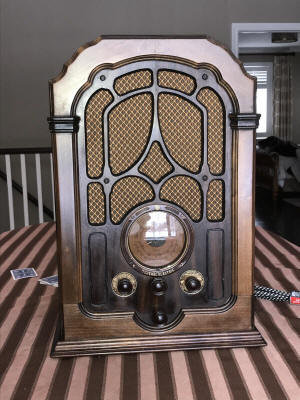
The gothic cabinet was intentionally dramatic and decorative. During the
Depression, radio manufacturers often used ornate cabinetry to make radios
appear like fine furniture.
Collector Interest Today
Among Canadian collectors, the K-80 is considered:
o relatively scarce
o technically advanced
o visually striking
o highly collectible
The
gothic cabinet and advanced chassis make it particularly desirable compared with
ordinary Depression-era tombstone sets.
Well-restored examples are admired because they combine:
o dramatic appearance
o excellent shortwave
capability
o unusually high build
quality
Historical Context
The
K-80 appeared during a fascinating moment in radio history:
o The Great Depression was
underway
o Radio had become the
center of family entertainment
o International shortwave
listening was exploding in popularity
o Manufacturers competed
aggressively on styling and technical sophistication
Owning a radio like the K-80 in 1934 would have signaled:
o financial stability
o modernity
o and social status
It
was the equivalent of owning a premium home entertainment system today.
|
|
The serial number D480 makes this set
an early production
Canadian example, which adds another layer of
historical interest. |
|