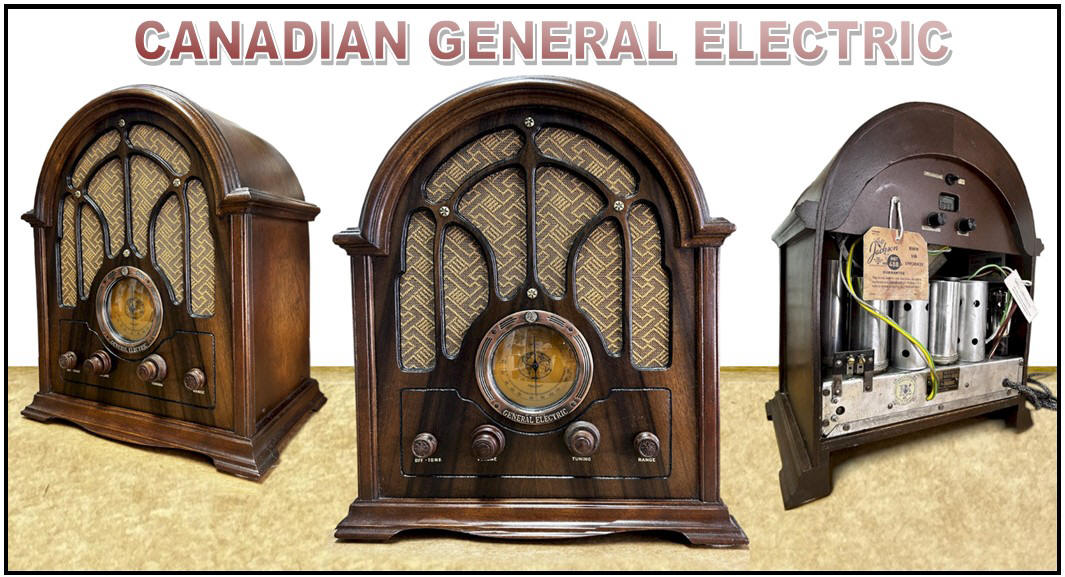
The
General Electric K-64 radio is a classic early–Depression-era tabletop
set that sits right at the transition between simple broadcast receivers and
more advanced multi-band “all-wave” radios. Although often casually referred to
as a 1934 set, it was actually introduced in late 1933 and sold through 1934,
which is why it is commonly associated with that year.
🏭
Manufacture and Origin
The
K-64 was produced by General Electric, with manufacturing centered in:
Bridgeport,
Connecticut, USA
Syracuse, New
York, USA
In
Canada, a closely related version was also built by Canadian General Electric
in Toronto, Ontario, reflecting GE’s common practice of parallel U.S. and
Canadian production for the same chassis design
💰
Original Selling Price (1933–1934)
List price:
$54.50 USD
To
put that into context:
This was a
mid-priced radio during the Great Depression
Roughly equivalent
to $1,200–$1,400 CAD today (inflation-adjusted estimate)
It
was marketed as a high-value, feature-rich set, offering shortwave
capability at a price “that can’t be touched” by competitors at the time.
📻
Technical Overview
The
K-64 is a 6-tube superheterodyne receiver with features that were quite
advanced for its price class:
Tube Lineup
58 (RF amplifier)
2A7
(mixer/oscillator)
58 (IF amplifier)
2B7
(detector/AVC/audio)
2A5 (output)
80 (rectifier)
Key Features
Two-band
operation:
Standard AM
broadcast
Shortwave
(approx. 5.4–15 MHz)
Superheterodyne
with RF stage
(better sensitivity/selectivity)
Electrodynamic
speaker
(field coil type)
AC-powered
(100–125V)
Power consumption
~75 watts
🎛
Design and User Features
The
K-64 stands out for several forward-looking design choices:
✦ “Airplane” Dial
One of GE’s early
uses of a round dial, replacing older rectangular “window” dials
Became a defining
style element of mid-1930s radios
✦ Dual (Coarse +
Fine) Tuning
Concentric knobs
allowed precise tuning—especially useful on shortwave
✦ Continuous Tone
Control
Used a potentiometer instead of a stepped switch, which later became standard
✦ Cabinet Style
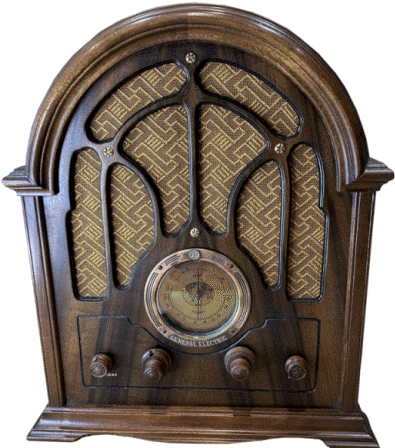
Classic cathedral
(Gothic arch) wooden cabinet
Compact but visually
striking—typical of 1933–1935 design trends
🔧
Relationship to RCA
An
interesting historical note:
The K-64 shares its chassis with the
RCA Model 121 radio, because GE was
manufacturing sets for Radio Corporation of America at the time .
This makes it part of a broader family of electrically identical radios sold
under different brand names.
🔢
About Serial Number 0223
While surviving records for GE serial numbers are limited, a number like
0223
suggests:
Early production
unit
(likely from the initial 1933–34 run)
Possibly assembled
near the beginning of the model’s lifecycle
GE
did not maintain widely accessible serial number logs for this period, so exact
production dates tied to serials are rarely traceable—but low numbers
generally indicate early manufacture, which can add collector interest.
 ⭐
Why the K-64 Matters
⭐
Why the K-64 Matters
The
K-64 represents a key moment in radio evolution:
Early adoption of
shortwave reception for consumers
Transition toward
modern dial design and controls
Strong
value
engineering during the Depression
Shared lineage with
RCA sets—linking two major industry players
🧭
Collector Perspective
Today, the K-64 is appreciated for:
Its
classic
cathedral aesthetics
Its
surprisingly
capable performance
Its role as an
entry-level “all-wave” set
This well-restored example—especially with this early Serial No. 223 —
can be both historically significant and visually striking in a collection.