Introduction:
Radio in a Time of Hardship
In
the early 1930s, radio was more than a household appliance—it was a lifeline. As
families across North America navigated the economic strain of the Great
Depression, the radio brought news, music, and a sense of connection to a wider
world. Manufacturers faced a difficult challenge: how to deliver meaningful
technological advancement at a price ordinary households could afford.
It
was in this environment that the General Electric K-64 emerged.
Introduced in late 1933 and widely sold through 1934, the K-64 represents a
pivotal moment in radio history—when advanced features such as shortwave
reception and precision tuning began to reach the middle-class consumer.
Though modest in price and production scale, the K-64 stands today as a
compelling artifact of innovation under constraint—a radio that quietly helped
shape the expectations of an entire generation of listeners.
Manufacturing and Origins:
An International Footprint
The K-64 was
produced by General Electric during a period when the company was deeply
intertwined with the broader North American radio industry. Manufacturing took
place primarily in the United States, with facilities in Bridgeport, Connecticut
and Syracuse, New York. At the same time, parallel production occurred in Canada
through Canadian General Electric in Toronto, Ontario, ensuring accessibility
for the domestic Canadian market.
This dual production model was typical
of the era and reflects the importance of regional manufacturing in reducing
costs and tariffs. It also underscores the scale of GE’s operations, which were
capable of supporting both domestic and international demand.
Technically, the K-64 shares its chassis
design with an equivalent model produced under the RCA banner, highlighting the
close corporate and engineering relationship between the two companies at the
time. This shared lineage places the K-64 within a broader family of radios that
combined standardized engineering with varied branding and cabinet design.
Price and Position in the Market
At a list price of approximately $54.50 USD, the K-64 was
positioned as a mid-range radio—neither a luxury item nor a budget compromise.
In the context of 1934, this represented a significant but attainable investment
for many households, roughly equivalent to over a thousand dollars in today’s
currency.
What made the K-64 particularly notable was the value it offered at this price
point. Rather than stripping features to reduce cost, General Electric chose to
include capabilities that were still considered advanced, especially in a radio
of this class. The result was a set that appealed to practical buyers while
quietly delivering a level of performance that exceeded expectations.
Technical Design:
A Six-Tube Superheterodyne
At the heart of
the K-64 lies a six-tube superheterodyne circuit, a design that had become the
industry standard for quality reception by the early 1930s. The tube complement
includes a radio frequency amplifier, converter, intermediate frequency stage,
detector with automatic volume control, audio output stage, and rectifier.
This configuration provided several key
advantages:
>
Improved sensitivity,
allowing the radio to pick up weaker signals
>
Enhanced selectivity,
reducing interference between stations
>
Stable operation,
particularly important for shortwave listening
The inclusion of a dedicated RF
amplifier stage was especially significant. Many lower-cost radios omitted this
stage, resulting in reduced performance. By retaining it, GE ensured that the
K-64 delivered strong reception across both of its bands.
Shortwave Capability:
A Window to the World
Perhaps the most
defining feature of the K-64 is its dual-band operation, which includes both the
standard AM broadcast band and a shortwave band covering approximately 5.4 to 15
MHz.
In 1934, shortwave was still a
relatively novel feature for consumer radios. It opened the door to
international broadcasts, maritime communications, and experimental
transmissions from around the globe. For many listeners, tuning across the
shortwave band was an experience of discovery—voices and signals appearing from
distant countries with no explanation other than the invisible reach of radio
waves.
By including shortwave capability in an affordable set, the
K-64 democratized access to this global dimension of radio listening. It
transformed the radio from a local entertainment device into a tool of
exploration.
User Experience:
Control, Precision, and Style
The K-64 also
reflects an evolution in how radios were designed for everyday use. Several
features distinguish it from earlier sets:
Dual Tuning
System
A concentric
tuning arrangement provided both coarse and fine control, allowing users to dial
in stations with greater accuracy—particularly useful on crowded or sensitive
shortwave bands.
Continuous Tone Control
Instead of a simple switch offering limited tonal presets, the K-64 employed a
variable tone control. This allowed listeners to tailor the sound to their
preference, a feature that would later become standard in radio and audio
equipment.
The “Airplane” Dial
Visually, the K-64 marked a departure from earlier rectangular dial windows. Its
circular dial—often referred to as an “airplane” dial—introduced a more modern
aesthetic that would come to define mid-1930s radio design. The layout made
tuning more intuitive while also giving the radio a distinctive visual identity.
Cabinet Design: The Enduring Appeal of the Cathedral
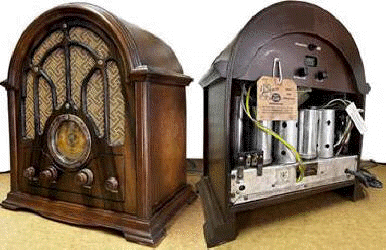
The K-64 is housed in a cathedral-style wooden cabinet, characterized by its
Gothic arch silhouette. This design was immensely popular during the early 1930s
and remains one of the most recognizable forms in vintage radio collecting
today.
The cabinet balances simplicity with
elegance. Its proportions are compact, yet the arched top and grille detailing
give it a presence that feels both traditional and refined. For many collectors,
the appeal of the K-64 lies as much in its visual character as in its technical
qualities.
Importantly, cabinet condition plays a major role in the
radio’s modern value. Original finishes, in particular, are highly prized, as
they preserve the authenticity and craftsmanship of the era.
Serial Number 0223:
A Glimpse into Early Production
The specific example identified by serial number 0223 is
especially interesting from a historical perspective. While detailed factory
records are no longer available, such a low serial number strongly suggests that
the set was produced early in the manufacturing run.
Early production units often carry subtle differences—minor
variations in components, assembly techniques, or materials—that reflect the
transition from design to full-scale production. For collectors, these early
examples can offer a more direct connection to the moment of introduction.
Although the serial number does not significantly increase
monetary value, it adds an element of historical intrigue and individuality to
the set.
Collector Value:
Modest but Meaningful
In today’s market,
the K-64 is considered a mid-tier collectible. Typical values range from:
@ $75 to
$175 CAD for unrestored examples
@ $200 to
$400 CAD for functional restorations
@ $400 to
$650+ CAD for fully restored, high-quality examples
These figures reflect a broader reality
in antique radio collecting: value is influenced as much by aesthetics and
condition as by rarity. The K-64 is not particularly rare, but it is widely
appreciated for its design and historical significance.
For many collectors, its value lies not in its resale price
but in its representation of a transformative period in radio history.
Conclusion: A Radio That Represents Its Time
The General Electric K-64 stands as a quiet
but important milestone in the evolution of consumer radio. It embodies a moment
when technology, design, and economic necessity converged to produce something
both practical and forward-looking.