|
The RCA Victor Model 128
A Depression-Era Masterpiece of Design, Engineering, and Global Imagination
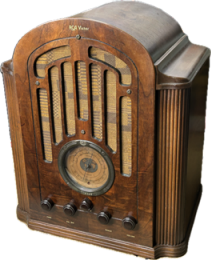
During the darkest years of the Great Depression, when economic uncertainty
gripped North America and much of the world, radio became more than
entertainment. It became companionship, education, escape, and a vital
connection to events unfolding far beyond one’s hometown. In countless living
rooms during the mid-1930s, families gathered nightly around glowing dials to
hear music, drama, political speeches, sporting events, and distant
international broadcasts arriving invisibly through the air.
Among the finest receivers available to those listeners was the RCA Victor Model
128 — one of the most elegant and technically sophisticated mid-sized radios of
its era. Introduced for the 1934–1935 selling season, the RCA 128 embodied
everything consumers admired about RCA Victor at the height of radio’s golden
age: advanced engineering, bold industrial design, and the promise of hearing
the world from home.
Today, the Model 128 remains one of the most admired early RCA tombstone radios
ever produced. Its striking cabinet, impressive performance, and enduring
historical significance have elevated it from a household appliance to a highly
collectible artifact of American technological and artistic achievement.
For
owners of surviving examples — especially an early-production set such as serial
number 492 — the radio represents not merely an antique, but a tangible
connection to one of the most transformative periods in communications history.
RCA Victor and the Rise of Radio Supremacy
By
the early 1930s, the Radio Corporation of America — better known simply as RCA —
had become one of the dominant forces in the global electronics industry.
Founded in 1919, RCA rapidly evolved into a technological powerhouse through its
leadership in broadcasting, vacuum tube development, and consumer radio
manufacturing.
Its
RCA Victor division emerged after RCA acquired the Victor Talking Machine
Company, integrating radio and phonograph technologies under one enormously
influential brand. During the 1920s and 1930s, RCA Victor became synonymous with
quality and innovation. The company’s manufacturing headquarters in Camden, New
Jersey, served as one of the most important centers of radio research and
production in the world.
The
RCA Model 128 was born from this environment of intense competition and rapid
technological advancement. By 1934, radio manufacturers were engaged in fierce
rivalry for consumer attention. Companies such as Philco, Zenith, Atwater Kent,
Stewart-Warner, and Sparton competed aggressively through styling, performance,
and increasingly sophisticated engineering.
Consumers were no longer satisfied with simple local broadcast reception. The
public had become fascinated with shortwave radio — the ability to hear foreign
countries, ocean liners, amateur operators, and international news broadcasts
from thousands of miles away. Manufacturers capitalized on this fascination by
marketing “all-wave” receivers that promised to bring the entire world into the
home.
RCA
answered this demand with radios like the Model 128.
The RCA 128: Designed for a Changing World
The
RCA 128 was introduced during late 1934 and sold through the 1935 model year. It
occupied an upper-middle position in RCA’s product lineup and originally
retailed for approximately $69.95 — a considerable sum during the Depression
years.
Adjusted for inflation, that price translates to roughly $1,500–$1,700 in modern
purchasing power. This was not an inexpensive appliance. Families purchasing an
RCA 128 were investing in one of the better home entertainment devices available
at the time.
Yet
buyers received tremendous value for their money.
The
Model 128 combined advanced engineering with remarkable visual appeal. It was
compact enough to fit comfortably in an average home while still delivering
performance that rivaled many larger floor consoles.
At
first glance, the cabinet itself commands attention. Collectors often debate
whether the set should properly be classified as a “tombstone” or a transitional
“cathedral” design due to its gracefully rounded upper shoulders. Whatever
terminology is used, the radio possesses extraordinary visual balance and
sophistication.
The
cabinet features carefully matched walnut veneers, Gothic-inspired side
pilasters, vertical grille bars, and an illuminated circular dial that
immediately draws the eye. The proportions are graceful without appearing
fragile, and the cabinet’s architecture reflects the blending of Art Deco
modernism with lingering Gothic influences characteristic of the early 1930s.
Unlike many mass-market radios of the period, the RCA 128 was clearly designed
to function as furniture as much as electronics. It was intended to occupy a
prominent place in the living room, projecting refinement and technological
sophistication.
Even today, nearly a century later, the cabinet design remains strikingly
modern.
Engineering Excellence and the “Magic Brain”
Beneath the elegant cabinet lay one of the Model 128’s greatest strengths: its
advanced six-tube superheterodyne chassis.
During the 1930s, RCA heavily promoted what it called “Magic Brain” circuitry —
a marketing term describing improved front-end RF engineering intended to
enhance sensitivity and selectivity. Although the phrase sounds theatrical
today, the technology behind it was genuine. RCA engineers had developed highly
effective tuned radio-frequency stages that significantly improved distant
station reception.
The
Model 128 included:
o A tuned RF amplifier
stage
o Three-band tuning
capability
o Standard AM
broadcast reception
o Two shortwave bands
o Automatic Volume
Control (AVC)
o Dynamic speaker
technology
o Tone control
o Illuminated
airplane-style tuning dial
o Vernier tuning for
precision station selection
This arrangement provided excellent overall performance for a radio of its size
and price class.
Particularly impressive was the set’s shortwave capability. During the
mid-1930s, shortwave listening became an international phenomenon. Listeners
tuned in to broadcasts from Europe, South America, Asia, and distant parts of
North America. Hearing London, Berlin, Moscow, or Havana from a modest home
receiver carried an almost magical quality.
For
many owners, radios such as the RCA 128 represented their first direct encounter
with the wider world.
The
radio’s performance reputation remains strong among collectors and restorers
today. Properly restored examples are known for warm audio quality, impressive
sensitivity, and surprisingly stable shortwave reception.
Serial Number 492:
A Very Early Production Example
The
significance of serial number 492 cannot be overstated.
Most surviving antique radios possess serial numbers indicating mid- or
late-production manufacture. A serial number this low strongly suggests that the
radio was produced very early in the manufacturing run at RCA Victor’s Camden
facility.
Early-production examples are often particularly fascinating to collectors and
historians because they may preserve original production techniques,
transitional components, or factory construction details later changed during
mass production.
Low
serial numbers also possess intangible historical appeal. Serial number 492 was
assembled when the Model 128 itself was still a new product — when RCA dealers
were first displaying the set in showroom windows and newspapers were
advertising its “world-wide reception” capabilities.
This radio likely entered service at a moment when international broadcasting
was rapidly reshaping public awareness. Within only a few years, radios such as
this would carry historic broadcasts surrounding the approach of World War II,
including speeches, news bulletins, and wartime reporting heard by millions.
To
hold such an early example today is to hold an object that stood at the
beginning of an extraordinary communications revolution.
The Collector Market and Modern Appreciation
The RCA 128 occupies a
respected place in today’s collector market. While many Depression-era radios
survive, relatively few combine aesthetic beauty, strong engineering, manageable
size, and historical significance as effectively as the Model 128.
Collectors particularly value the radio for several reasons:
o Exceptional cabinet
design
o RCA pedigree
o Excellent shortwave
performance
o High-quality veneer
construction
o Compact yet visually
commanding proportions
o Relative scarcity
compared to mass-produced competitors
As
a result, surviving examples remain highly desirable.
Unrestored radios in poor or incomplete condition may sell for several hundred
dollars, while high-quality restored examples frequently command significantly
higher prices. Professionally restored sets with excellent original veneer,
accurate grille cloth, rebuilt electronics, and authentic finishes can exceed
$1,500 or more in today’s collector market.
The
quality of restoration dramatically affects value. Many collectors seek radios
that preserve original finishes and authentic construction details rather than
heavily refinished examples lacking historical integrity.
For
early serial-number radios such as number 492, provenance and originality become
especially important. An early-production RCA 128 retaining substantial original
components and cabinetry represents a meaningful historical artifact as much as
a collectible radio.
An Enduring Symbol of Radio’s Golden Age
The
RCA Victor Model 128 survives today because it represents far more than obsolete
technology.
It
captures a unique moment in history when radio stood at the center of everyday
life. Before television, before the internet, and before modern digital
communication, radio connected ordinary families to music, culture, politics,
and the wider world in ways previously unimaginable.
The
Model 128 embodies the optimism of that era. Even amid economic hardship,
manufacturers like RCA continued striving to create products of beauty,
sophistication, and technical excellence. The radio’s craftsmanship reflects an
age when consumer goods were designed not merely for utility, but for permanence
and pride of ownership.
Nearly a century after its introduction, the RCA 128 continues to fascinate
collectors, historians, restorers, and enthusiasts. Its glowing dial, warm
sound, and elegant walnut cabinet remain evocative reminders of radio’s golden
age and of the remarkable engineering culture that produced it.
For
the owner of serial number 492, the radio represents something especially rare:
an early surviving witness to the beginning of one of RCA Victor’s finest
achievements.
It is not merely a radio —
it is a surviving voice from 1935.
|